


Forward Deployed Engineer: OpenAI Launched Today. Anthropic Launched First. The Headlines Missed Who Just Won.
$5.5B — that's what two frontier labs put behind forward-deployed-engineering businesses in 8 days, and Goldman's Marc Nachmann named exactly what it bought: “democratize access to forward-deployed engineers.” In the same fortnight the labor market doubled — 187 → 399 LinkedIn JDs, with AI/ML now required by 80% (up from 71%) and salary disclosed on 55% (up from 11%). This is the complete 2026 read on the role: skills, salary, path in, and the explicit answer to “AI Engineer or FDE?”
- Two frontier labs put a combined $5.5B behind forward-deployed-engineering businesses in 8 days — OpenAI's $4B Deployment Company and Anthropic's $1.5B enterprise AI services venture (May 2026).
- Dexity's LinkedIn scan found FDE job postings doubled from 187 to 399 in 14 days (Apr 28 to May 11–12, 2026, US market).
- 80% of the 399 FDE JDs in Dexity's May 2026 scan require at least one AI/ML skill, up from 71% in April.
- Disclosed US pay for Forward Deployed Engineers runs $150K–$325K across mid-to-lead levels, per Dexity's analysis of 399 JDs.
- Salary disclosure on FDE postings jumped to 55% in May 2026, up from 11% in April, in Dexity's LinkedIn scan.
- Gartner predicts 70% of enterprises will abandon agentic-AI deployments because of FDE supply, not technology (via CIO Magazine, May 6, 2026).
What does a forward deployed engineer make in 2026?
Disclosed US pay bands for Forward Deployed Engineer roles run roughly $150K–$325K across mid-to-lead levels — higher at top AI labs — and the posting pool has more than doubled in a year (187 → 399 → 451). The full market story, and why two frontier labs just put $5.5B behind the role, is below.
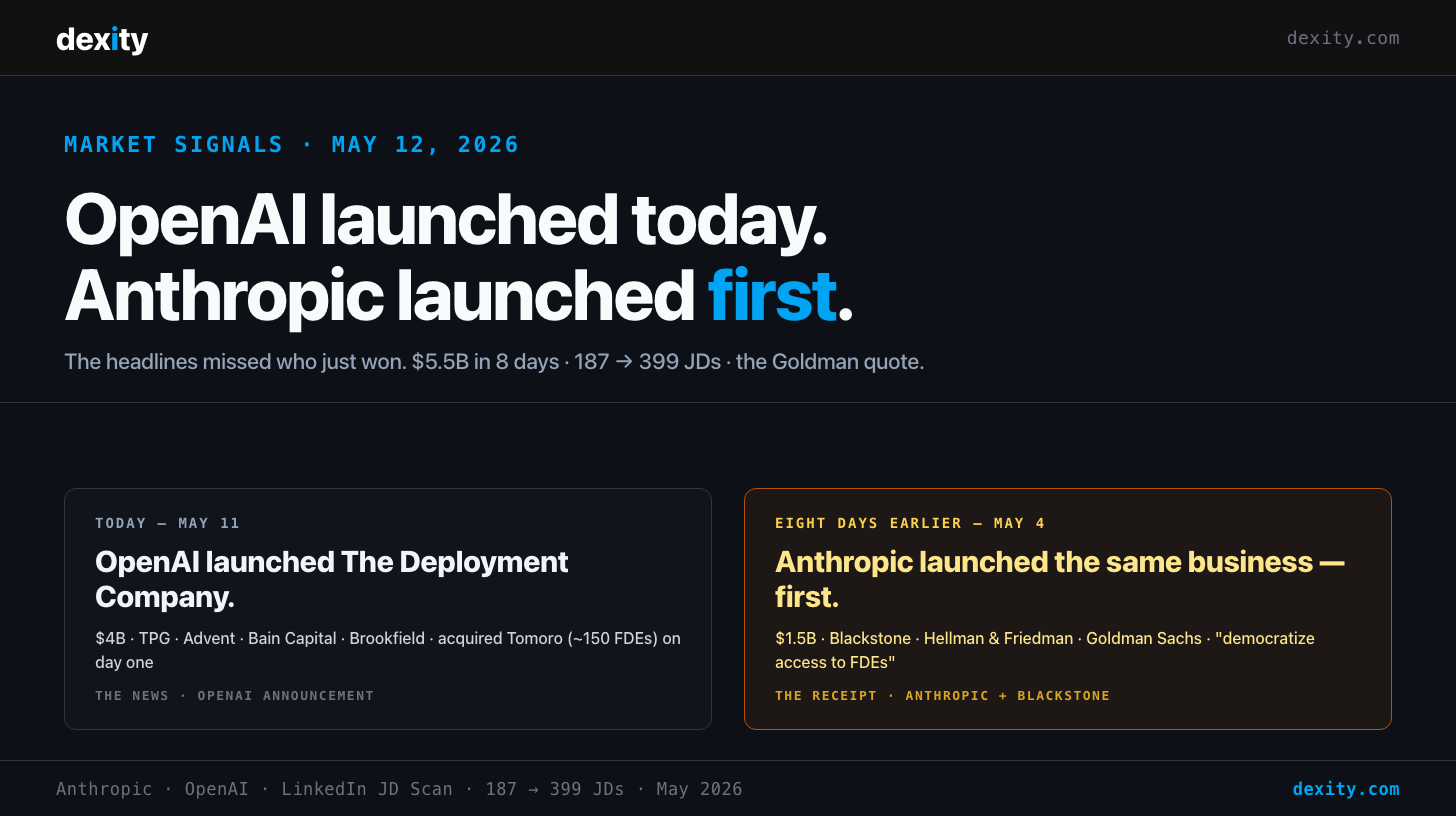
OpenAI launched today. Anthropic launched first. The headlines missed who just won.
OpenAI's vehicle is called The Deployment Company — $4B for forward-deployed engineering, backed by TPG, Advent, Bain Capital, and Brookfield. Anthropic's, launched eight days earlier on May 4, is a $1.5B enterprise AI services venture with Blackstone, Hellman & Friedman, and Goldman Sachs. Most of the LinkedIn feed today is reposting one of those two announcements as if they're separate stories.
They're the same story.
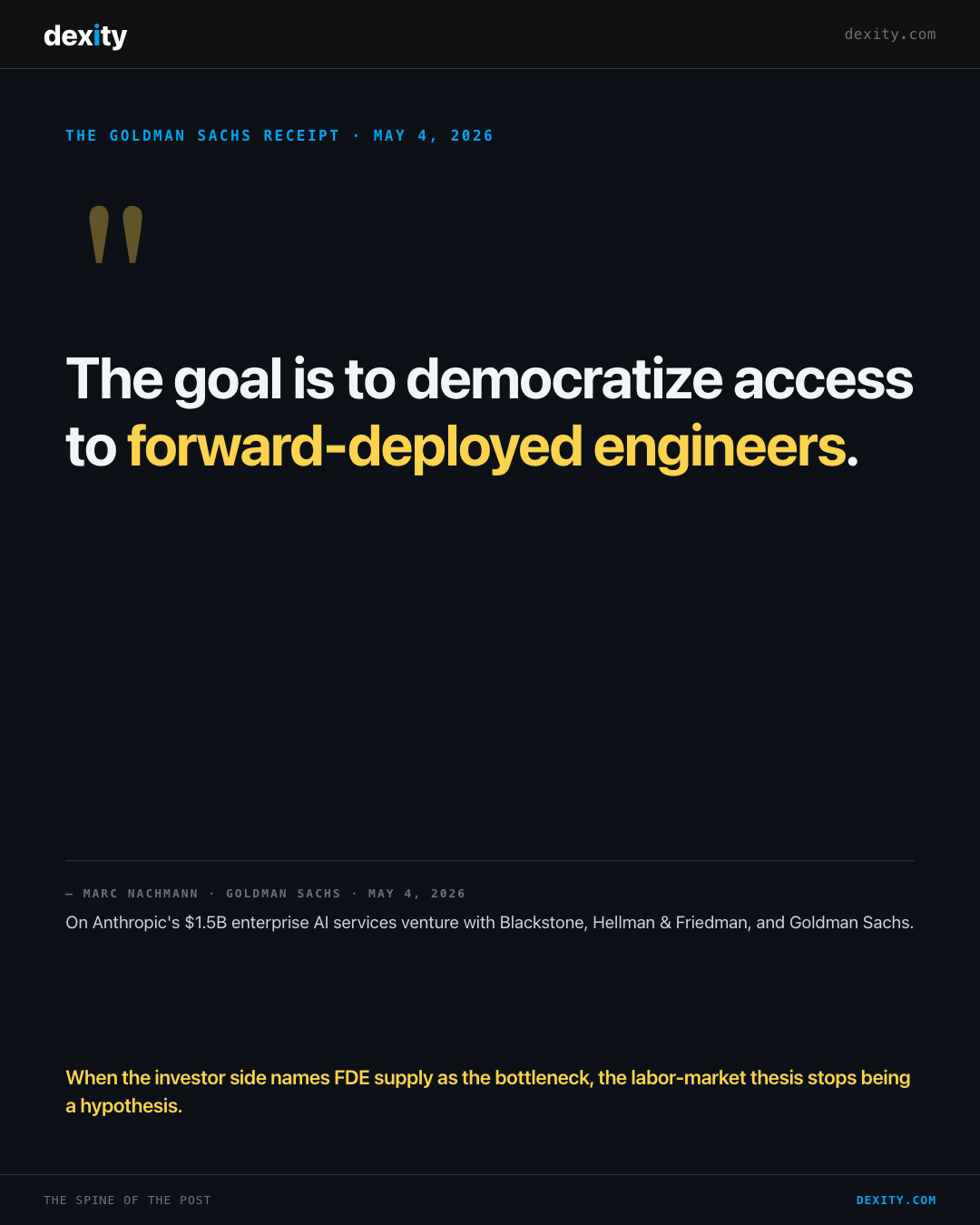
The line that matters more than either announcement came from Goldman's Marc Nachmann, sitting on the Anthropic deal: the new venture's purpose was to "democratize access to forward-deployed engineers."
Translation: the labs aren't capital-constrained. They are FDE-constrained. The bottleneck is one specific type of engineer — and the headlines today are naming everything except who.
This piece is the full read on that role: what it actually is, what the skill demand looks like across 399 fresh JDs, what the salary band is, the explicit decision logic between AI Engineer and FDE if you're torn between the two, the fastest path in by background, and what to do this week if you're in the window.
What does 14 days of JD data confirm?
I have been tracking the Forward Deployed Engineer market for the last year — the rolling JD scans, the cohort conversations, the AMA questions from working engineers. Two weeks ago, I posted the first FDE scan: 187 JDs across the US market, $150K–$325K, 71% requiring AI/ML, the role spreading fast but without a stable definition across companies.
I re-ran the scan this week to confirm what the announcements suggested.
399 JDs, up from 187. The pool doubled in 14 days.
80% require AI/ML, up from 71%. The role is consolidating around AI deployment specifically. The remaining 20% are mostly older "Forward Deployed" postings that haven't refreshed yet.
Compensation disclosure jumped to 55%, up from 11%. Companies are competing on transparency now — which happens when the role has enough definition that hiring managers know what to pay.
New names on the hiring list. OpenAI. Anthropic. Notion. Vercel. Snorkel AI. Together AI. Glean. Cohere. Reflection. Plus Deloitte alone is running 70 simultaneous FDE postings. Google is at 20. (By mid-2026 this became a full corporate build-out — see the skills the FDE hiring boom is hiring for: Tredence's 200-FDE practice, TCS converting up to 8,900 staff, and more.)
The 8-day frontier-lab convergence and the 14-day labor-market doubling are the same signal at two altitudes. The labs named the function. The hiring data confirmed it.
The trend since — an independent July scan
The April and May figures above came from LinkedIn scans. To check the direction independently, we re-scanned in July across public ATS boards (Greenhouse / Lever / Ashby) — a different method, dated and archived so the series is verifiable:
| Scan | Method | FDE JD pool | AI/ML required |
|---|---|---|---|
| Apr 28, 2026 | 187 | 71% | |
| May 11–12, 2026 | 399 | 80% | |
| Jul 2026 | ATS boards | 191 strict-title · 451 incl. applied / solutions variants | 88% |
Two independent methods point the same way: the pool is still growing and the AI/ML requirement is still hardening — 88% in the July scan, up from 80%. Salary disclosure across the broader ATS pool settled around ~35%, below May's 55% LinkedIn spike, because the wider net catches more early-stage postings that haven't published bands yet. The consolidation thesis holds across both data sources — which is a stronger signal than any single scan.
Which other labs and firms are hiring FDEs?
OpenAI and Anthropic got the headlines. They are not the only labs moving.
- Google DeepMind — Forward Deployed AI Engineers embedded via Accenture, Capgemini, Deloitte, HCLTech, PwC, TCS for Gemini Enterprise (Cloud Next 2026, April). Citi Wealth's "Citi Sky" agent is the named case study.
- Databricks — productized "AI FDE" team listed by that exact name on its careers page. Not "applied AI." Not "customer engineering." AI FDE. The category gets the title.
- Cohere + Mistral — both hiring "Applied AI / Forward Deployed ML Engineer" roles across US and EMEA in 2026. The phrasing varies. The function does not.
- Accenture — "Reinvention Deployed Engineers" (~30K Claude-trained consultants) — Accenture's house name for the FDE archetype.
- EPAM — 250 "FDE Black Belts" inside a 10K-architect Anthropic practice.
CIO Magazine called FDEs "the new AI limiting factor" on May 6, citing a Gartner prediction that 70% of enterprises will abandon agentic-AI deployments because of FDE supply, not technology.
This is what a category looks like when it stops being a hiring experiment and starts being a market.
What are the labs actually bidding for?
The labs are not bidding for "AI engineers." They are not bidding for "senior SWEs." They are bidding for the rare engineer who carries BOTH technical depth AND customer-facing experience. The overlap of two skills most engineers spent the last decade picking between.
SWEs and MLEs went technical depth. PMs and solutions roles went customer-facing. The small overlap — the engineers who got told "too technical for PM, too customer-facing for engineering" — that is exactly who the labs are buying. That combination is the entire moat.
If that's you, here's what just happened to your market:
Low competition — because both signals on one resume is rare. The supply side is thin precisely because most engineers don't carry both. That thinness is structural, not temporary.
High opportunity — because $5.5B of PE capital just admitted FDE supply is the bottleneck. Two frontier labs. The investor side naming it out loud. The labor market doubling its postings in 14 days. All four pieces of evidence point at the same engineer profile.
This is the strongest hiring window the market will give you in 2026. It is also the narrowest.
What does FDE actually mean?
The title is newer than the work. Forward Deployed Engineers have been showing up in AI companies for years — they were just called different things. Now the category has a name, a salary band, and (as of this week) productized billion-dollar businesses around it.
The defining characteristic: you are the technical owner inside the client's environment, not your company's codebase. If the deployment fails, that's on you.
How FDE differs from adjacent roles people confuse it with:
vs Software Engineer. SWE builds product in-house and hands it off. FDE deploys inside the client's environment and owns outcomes there. You're not building a product; you're making a product work in a specific, messy real-world context.
vs Sales Engineer. SE supports the deal. FDE lives post-deal. Accountable for the thing actually working in production after the contract is signed.
vs Solutions Architect. SA designs the blueprint and hands it over. FDE owns the full implementation end-to-end and stays accountable until it ships.
vs PM. PM owns the roadmap. FDE owns the technical integration inside a specific customer environment. The scope is narrower, the hands-on bar is higher.
"Without FDEs, we risk having thousands of customers stuck in pilot purgatory — signed up, but not successfully deployed." — Sarah Khalid, FDE Director, Salesforce
That's the job in one sentence. The FDE exists because enterprise AI doesn't deploy itself.
FDE vs AI Engineer: which should you choose?
This is the section most readers are here for. Both roles write production-grade code daily. Both work with AI/ML systems. The difference is where and for whom.
AI Engineers build features inside their own company's product. FDEs deploy AI systems inside the client's environment — different data, different infrastructure, different stakeholders, and a delivery clock that resets with every new client. AI Engineers optimize for the product. FDEs optimize for the client's specific outcome.
| FDE | AI Engineer | |
|---|---|---|
| You own | AI systems in client production | AI features in your product |
| Customer exposure | Deep — weeks to months onsite | Minimal — internal teams only |
| Core skill mix | Technical depth + client delivery — simultaneously | Technical depth |
| Interview | Coding + systems design + client scenario | Coding + systems design |
| Salary (May 2026) | $150K–$325K (399 JDs) | $153K avg (Indeed) |
| Best path in | SWE / DS / MLE / Solutions / TPM with client-facing experience | Backend / Full-stack SWE |
| Travel / onsite | Often required | Rare |
Who should go for AI Engineer:
- You love heads-down product engineering. Long arcs inside one codebase energize you.
- You want to ship features and iterate fast on the same product over months.
- Customer interaction is draining or distracting, not energising.
- You optimise for technical depth — internals of frameworks, model architectures, performance tuning.
- Your background: strong backend, full-stack, or ML-internals engineering.
Who should go for FDE:
- You're energised by customer problems and ambiguous delivery contexts. The messy half of integration is the part you find interesting, not the part you avoid.
- You enjoy translating between non-technical stakeholders and production-grade systems.
- You can hold accountability under client pressure — including when the AI does something stupid and you're the one explaining it.
- Your background already shows the both-sides signal: SWE who worked on customer-facing projects; DS or MLE with consulting / client delivery; solutions architect with deep technical ownership; technical PM with real implementation history.
Torn between the two? The fastest disambiguator: think about the last engineering project you were proud of. Was the proudest part the architecture, or was it the moment you got the customer's nod that "yes, this is what we needed"? AI Engineer is the first. FDE is the second.
What do the 399 JDs actually ask for?
Refreshed from the May 12 scan.
Core technical skills:
| Skill | % of JDs | Notes |
|---|---|---|
Python |
51% explicit (~80% baseline) | Frequently unstated — assumed baseline |
| APIs & system integration | 17% | Integration architecture depth |
| AWS / cloud (GCP, Azure) | 14% explicit | Multi-cloud fluency preferred |
| Data engineering / SQL / pipelines | 13% | Becoming essential for client-side deployments |
| TypeScript / React | 9% React explicit | Front-end for client tooling and deployment visibility |
Kubernetes / Docker / Terraform |
10–15% combined | Infrastructure provisioning baseline |
AI/ML skill clusters (80% of JDs require at least one):
| Cluster | JD coverage | What employers want |
|---|---|---|
| Agentic AI development | 150 JDs | Multi-agent systems, LangGraph, CrewAI, AutoGen, agent orchestration, agent reliability |
| AI/ML system integration & deployment | High | MLOps / LLMOps, LLM enterprise integration via APIs, MLflow, scalable AI systems |
| AI/ML evaluation & optimization | High | Model monitoring, prompt management, evals, fine-tuning, RAG pipelines, observability |
| Emerging GenAI / LLM tech | High | Bedrock, Databricks AI Gateway, vector DBs, MCP, Claude Code, Responses API, OpenAI Agents SDK |
Trajectory note: AI/ML isn't an add-on for FDE — it's the core. The 80% requirement (up from 71% in April) reflects the role consolidating into primarily an AI-deployment function. If your JDs from a year ago didn't mention LangChain or agent orchestration, the current ones almost certainly do.
Self-assessment heuristic: Read 10–15 current FDE JDs. If you can read the body paragraphs without needing to look up more than 2–3 terms per JD, you are roughly inside the 80%. If you need to look up more than 5 terms per JD, the gap is real but closable in 4–8 weeks of focused shipping.
What is the FDE salary and hiring landscape?
55% of JDs now disclose salary (up from 11% in April), so this band is the most accurate read of the role's compensation at any point so far.
| Level | Range | Disclosed examples (May 2026) |
|---|---|---|
| Mid | $113K–$208K | Tagup: $130K–$160K |
| Senior | $137K–$282K | Snorkel AI: $172K–$300K · Red Hat: $184K–$305K · Kore.ai: $180K–$230K |
| Lead / Manager | $200K–$325K | David Joseph & Co: $175K–$250K · Acceler8 Talent: $150K–$250K + equity |
The 55% disclosure rate is itself a signal. Companies disclose salary when they need to compete on transparency to attract candidates — which happens precisely when supply is constrained. Treat the bands as floor-leaning rather than ceiling — top-tier AI shops will pay above, often with equity that significantly changes total comp.
Largest-volume hirers (May 2026):
| Company | JDs | Salary (if disclosed) |
|---|---|---|
| Deloitte | 70 | $113K–$282K |
| 20 | $153K–$300K + bonus + equity | |
| Tagup | 4 | $130K–$200K |
| Acceler8 Talent | 4 | $150K–$250K + equity |
Other notable names in the May 2026 hiring pool: OpenAI, Anthropic, Scale AI, Tesla, Cohere, Notion, Vercel, Cursor, HeyGen, H2O.ai, Labelbox, Unstructured, SuperAnnotate, StackAI, Snorkel AI, Together AI, Glean, Reflection, Mistral, LiveKit, Arcade.dev, Parloa, Kore.ai, Seekr, plus 100+ others.
When Deloitte runs 70 simultaneous FDE postings, the work has moved past pilot stage at their clients. They are now staffing for sustained deployment volume. That's a Big Three consulting firm building a P&L line around the role.
What is the FDE interview format?
Three components, based on practitioner signals:
1. Coding round. Standard SWE coding — LeetCode-style or practical implementation. Doesn't need to be exceptional; needs to clear a competency bar. The interview isn't primarily testing algorithm optimization.
2. Systems design. Architecture and integration design, increasingly AI-flavored. Expect prompts like: design an LLM-powered workflow for a client use case, or architect an AI observability system for an enterprise deployment. Know how to design with LLM APIs under constraints: latency, cost, reliability, fallback handling.
3. Client scenario. A consulting-style case. "The client's deployment broke after go-live. Walk me through how you handle it." Tests communication under pressure, problem decomposition, and whether you can hold accountability without blaming the client or the product.
The round-three filter. The client scenario round is the round that filters out engineers who've never worked client-facing. Pattern recognition for what to escalate, when to push back, and when to just fix it — that's what's being tested. Practitioners report this round catches more candidates than the technical ones.
Practitioner signal worth flagging: OpenAI API design questions are appearing in systems design rounds across the May 2026 hiring pool. Know how to architect with LLM APIs, not just use them.
What is the fastest path into FDE, by background?
The fastest path in is not deeper pure engineering. It's combining technical credibility with a customer-facing track record.
| Background | What carries over | The gap to close |
|---|---|---|
| Backend / Full-stack SWE | APIs, system design, deployment, Python — ~70% of the stack |
Client-facing experience + AI/ML skills (LLM APIs, RAG, agents). One deployed client integration project closes most of the gap. |
| DS or MLE with client delivery | Model deployment, ML fundamentals, Python |
Client delivery framing on the resume. If you've deployed models in client environments, you're already doing the job — the gap is mostly narrative. |
| Solutions Architect | System design thinking, stakeholder communication, enterprise architecture | Implementation depth. SA designs what FDE builds. The gap is hands-on delivery ownership, not technical concepts. |
| Technical PM with implementation history | Product and stakeholder communication, requirements translation | Hands-on delivery credibility. The bar is that "implementation history" is real — not just oversight or ticket-writing. |
No PhD-level math prerequisite. FDE interviews test systems thinking, client scenario handling, and code quality — not model mathematics or probability theory. The technical bar is production-grade engineering, not academic ML depth.
The one non-negotiable signal regardless of background: evidence that you deployed something in a client's environment and owned the outcome. Not contributed to. Not designed. Owned, shipped, and were accountable for it working.
What to surface on your resume and LinkedIn: - Client environments you've deployed to (not just internal systems) - End-to-end ownership language — "owned" not "contributed to" - AI/ML work that shipped to production, not just modeled or prototyped - Communication with non-technical stakeholders under delivery pressure
What does a strong FDE portfolio look like?
FDE portfolios are fundamentally different from standard engineering portfolios. Hiring managers want evidence that you can own end-to-end delivery, work with real constraints, and communicate outcomes to non-technical stakeholders. Technical depth alone doesn't signal this.
Weak vs strong FDE portfolio:
| Weak (avoid) | Strong (target) |
|---|---|
| Pure technical projects with no customer context | Customer problem → solution → measurable impact |
| Backend or ML only, no user-facing | Full-stack with demo-ready interface |
| Long development cycles (months to build) | Rapid prototypes built in days or weeks |
| Polished but isolated systems | Messy integration with real constraints (legacy APIs, security, bad data) |
| No documentation of trade-offs | Clear articulation of what you chose and why |
| Solo projects only | Evidence of working across technical and non-technical stakeholders |
3–5 projects to ship:
- Client-style POC — end-to-end solution for a simulated business problem with a working demo.
- Integration project — connect an AI system to a legacy API, messy database, or enterprise tool.
- Customer-facing AI app — chatbot or agent with a non-technical user interface (Streamlit, Gradio).
- Data pipeline + executive dashboard — ETL from messy sources → analysis → output a non-technical stakeholder can read.
- Technical case study — written breakdown: the constraint, your approach, the outcome, what you'd do differently.
The signal hiring managers are actually looking for: can you operate like a startup CTO dropped into a client's environment — owning the problem, adapting to what's there, and shipping something that works? GitHub repos where the README explains the business problem, not just the code. Demo videos or live apps.
Who is FDE not for?
The role has real downsides and is wrong-fit for a meaningful slice of engineers.
Engineers who want to stay heads-down in the codebase. Client interaction isn't optional — it's the core of the job. If customer-facing work feels like a distraction, this will be a bad fit regardless of technical ability.
People who find ambiguity and delivery pressure draining. Client deployments are rarely clean. Requirements change mid-project, integrations break in production, and the stakeholder on the client side may not understand what they asked for. The job requires tolerating that without spiraling.
Engineers early in their career without deployment experience. This role requires owning outcomes, not just writing code. Without prior deployment accountability, you won't have the pattern recognition for when to escalate, when to push back, and when to just fix it.
PMs without hands-on implementation history. The technical bar is real. Stakeholder management experience doesn't substitute for it.
If two or more of these describe you, the AI Engineer track (or remaining in your current role and deepening) is the higher-leverage move.
Three reads, by where you sit
If you got cut six months ago and are still looking. This is the seat most likely to reopen at your level — it did not exist as a named role when you last interviewed. The 80% AI/ML bar is the screen. One agentic project shipped publicly in the gap — with a README that documents what the AI got wrong and how you caught it — closes most of it. Compensation floor at mid level: $113K. Ceiling at senior: $282K. Six months ago, you would not have known either number with this confidence.
If you survived the cut at your current company. Your senior SWE title and an FDE title now read approximately 70% the same JD, with one delta: client deployment ownership. The lateral window is wider this quarter than it has been at any point in the role's existence. The pool of qualified candidates is small enough that hiring managers are still flexible on background; the pool of engineers who know the role exists is also small enough that supply hasn't caught up. Both shrink in six months.
If you are a solutions engineer, TPM, or consultant with technical chops. The market is asking for exactly your shape. The "non-traditional" background you've apologised for on resumes is now the JD. Don't lead with "I'm not really an engineer" — lead with "I've owned delivery in client environments." That's the screening signal.
What should you do this week?
Three actions, in order.
1. Pull the JDs. Go on LinkedIn. Search "Forward Deployed Engineer" plus your region or timezone. Read 10–15 postings in full. Not the headlines. The body paragraphs. The "preferred" sections. You are looking for the line that recurs in two out of three — that phrase is the actual screening signal. In May 2026 it is almost always agentic tooling fluency, LLM-deployment experience, or evals.
2. Name the gap. Two columns. Left: what your last six months of work demonstrates clearly. Right: what the JDs are explicitly asking for. The diff is what you ship in the next four weeks. The diff is almost always smaller than people expect — usually one project, not a curriculum.
3. Write one public artifact. A project, a blog, a README. Document the deployment context, the constraint that mattered, the call you made when the AI failed in production-shaped conditions. That artifact is what gets past the round-three client-scenario filter — every candidate who passes that round has a version of this.
Why this update exists
OpenAI productized the function on May 11. Anthropic did it eight days earlier. The Goldman quote named the bottleneck. The labor market doubled its postings in fourteen days. The credentialing layer is forming.
Two weeks ago, I called the two-skill engineer profile "the job description." This week, $5.5B of PE capital paid for exactly that. The thesis around when to move has changed in eight days, twice.
The macro signal is unambiguous. The role is named, the salary is publicized, the frontier labs have built productized businesses around it, and the supply side is publicly thin enough that an investor at Goldman Sachs is using the word democratize to describe access. If you fit the profile — technical depth + customer-facing experience — this is the cleanest hiring window of 2026.
Why is the window closing?
The naming already happened — and naming is what starts the clock. Two frontier labs put $5.5B behind forward-deployed engineering in 8 days, and an investor at Goldman Sachs used the word democratize to describe access to the role. Once the bottleneck is named out loud by the people writing the checks, the supply side moves to close it. The uncontested window is the gap between the naming and the catch-up — and that gap opened this month.
The role is consolidating in weeks, not quarters. 187 → 399 JDs in 14 days. AI/ML requirement 71% → 80%. Salary disclosure 11% → 55%. Every one of those shifts is definition hardening. While the definition is still loose, hiring managers stay flexible on background; as it hardens, the "non-traditional" path that reads as an asset today reads as a gap tomorrow.
The lateral window is the widest it will ever be. A senior SWE title and an FDE title now read roughly 70% the same JD, separated by one delta: client-deployment ownership. The pool of engineers who qualify is small, and the pool who even know the role exists is smaller still. Both shrink in six months.
Frequently asked questions
What does a forward deployed engineer make in 2026?
Disclosed US pay bands run roughly $150K-$325K across mid-to-lead levels, higher at top AI labs. By level, the article lists Mid at $113K-$208K, Senior at $137K-$282K, and Lead/Manager at $200K-$325K, with 55% of May JDs disclosing salary (up from 11% in April).
What is a forward deployed engineer?
An FDE is the technical owner inside the client's environment, not their own company's codebase. Rather than building a product and handing it off, they make a product work in a specific, messy real-world context and stay accountable for the deployment until it ships.
FDE vs AI Engineer: which one should I go for?
Both write production-grade code and work with AI/ML, but AI Engineers build features inside their own product while FDEs deploy AI systems inside the client's environment. Go AI Engineer if you love heads-down product work and find customer interaction draining; go FDE if you are energised by customer problems, ambiguous delivery, and translating between non-technical stakeholders and production systems.
What skills do FDE job descriptions ask for?
Across the 399-JD scan, Python is a near-universal baseline (~80%), with APIs and system integration, cloud (AWS/GCP/Azure), data engineering/SQL, and Kubernetes/Docker/Terraform recurring. 80% of JDs require at least one AI/ML skill cluster, spanning agentic AI development, AI/ML integration and deployment, evaluation and optimization, and emerging GenAI/LLM tech.
What is the FDE interview like?
Three components: a standard SWE coding round that needs to clear a competency bar, a systems design round that is increasingly AI-flavored (designing with LLM APIs under latency, cost, and reliability constraints), and a client scenario round. The client scenario is the filter that catches the most candidates because it tests whether you can hold accountability under pressure without blaming the client or product.
What is the fastest path into FDE?
Not deeper pure engineering, but combining technical credibility with a customer-facing track record. Backend/full-stack SWEs already carry ~70% of the stack and need one deployed client integration plus AI/ML skills; the one non-negotiable signal regardless of background is evidence you deployed something in a client's environment and owned the outcome.
Source: LinkedIn FDE JD scans — 187 (Apr 28, 2026) refreshed to 399 (May 11–12, 2026, US market, 30-day rolling, mid through lead level); independently re-scanned Jul 2026 across public ATS boards (191 strict-title / 451 incl. applied-solutions variants; 88% AI/ML), archived at data/2026-07/. PE capital deals: Anthropic enterprise AI services venture (May 4, 2026) · OpenAI Deployment Company (May 11, 2026). Goldman Sachs commentary (Marc Nachmann) via Fortune, May 4, 2026. CIO Magazine, May 6, 2026. Google Cloud Next 2026, Accenture–Anthropic and EPAM–Anthropic partnerships. Sarah Khalid quote — Salesforce FDE leadership, 2025. · JD dataset for this role · Dexity.com
More in Career Transitions
All Intel →Prompt Engineer in 2026: Is It Still a Job?
Short answer: as a standalone title, barely — as a skill, it's everywhere. The 2023 "magic words" craft is fading (IEEE Spectrum called manual prompt engineering "dead" once automated optimization started beating hand-crafted prompts), and Indeed job searches for "prompt engineer" that spiked to ~144 per million in 2023 have settled to ~20–30. But the underlying skill exploded and folded into AI-engineer and AI-PM roles: in Dexity's scan of 390 live AI-engineer job descriptions, prompting shows up bundled with evals (56%) and agents (50%) — the job is measurable reliability, not clever wording. This guide covers whether it's still a job, what the skill actually is now (structured prompts, evals, context engineering, agent instructions), what it pays, and how to make it a real career.
Career TransitionsAI Agent Engineer in 2026: Role, Skills, Salary & How to Become One
"AI agent engineer" is the fastest-forming title in AI — but it's becoming a cross-role requirement more than a single settled job. In Dexity's live-JD scans, agentic-AI work now appears in 50% of AI-engineer postings, 150 of 399 forward-deployed-engineer postings, and 28% of product-manager postings. The salary reflects how new the title is: the same words return ~$111.5K (ZipRecruiter) to ~$192.8K (Glassdoor "Agentic AI Engineer"), with frontier-lab totals far higher — so there's no single number. This guide defines the role, how it differs from AI, ML, and prompt engineering, what the JDs require, the frameworks to learn (LangGraph, CrewAI, MCP), what it pays, how to become one, and whether the boom lasts.
Career TransitionsWhat Does a Machine Learning Engineer Career Look Like in 2026?
Machine learning engineering is still one of the highest-paid engineering careers in 2026 — but it's now a distinct track from the AI-engineer boom, not the same job. In Dexity's analysis of 247 live US ML-engineer postings, 244 of 247 require a deep-learning framework (PyTorch or TensorFlow) and 82% require Python — the role is about training and operating models, where the AI engineer builds *with* pre-trained ones. Total comp runs high: Built In puts the average near $212K, Levels.fyi's median total comp lands around $260K–$272K, and big- tech medians reach far higher. Here's what the role is, what the JDs require, what it pays by level, and how to break in.